What the Modern Flex Wash Says About the Future of Car Washing
Zac Hamilton, Channel Sales Manager, AVW Equipment
|
As express-heavy markets grow more competitive, some operators are rethinking how full-service car washing can work for today’s customer. Express exterior washing reshaped the car wash industry by giving customers something they clearly valued: speed, convenience and consistency. For many operators, the model created a simpler labor structure and higher vehicle volume. But in competitive markets, speed alone may not be enough to stand out.
International Carwash Association’s (ICA) CAR WASH Pulse™ Q1 2026 report noted stable consumer demand while highlighting rising price sensitivity, slower membership growth and market saturation. For operators, that tension creates a familiar question: How do you offer more value without giving up the efficiency customers have come to expect?
For some, the answer is a modern version of flex.
The modern flex model
Not old-school full service. Not express-only. The modern flex model sits in the middle, giving customers a more complete car care experience while relying on process, layout and equipment design to keep the operation moving.
Dave Dittman, CEO of Super Dave’s Car Wash in Richmond, Texas, saw the challenge firsthand. In the Houston market, he says, express washes are everywhere, and many are competing heavily on price.
“You cannot move away from your North Star, which is you’re putting out the cleanest, shiniest, driest car of anybody else,” Dittman says.
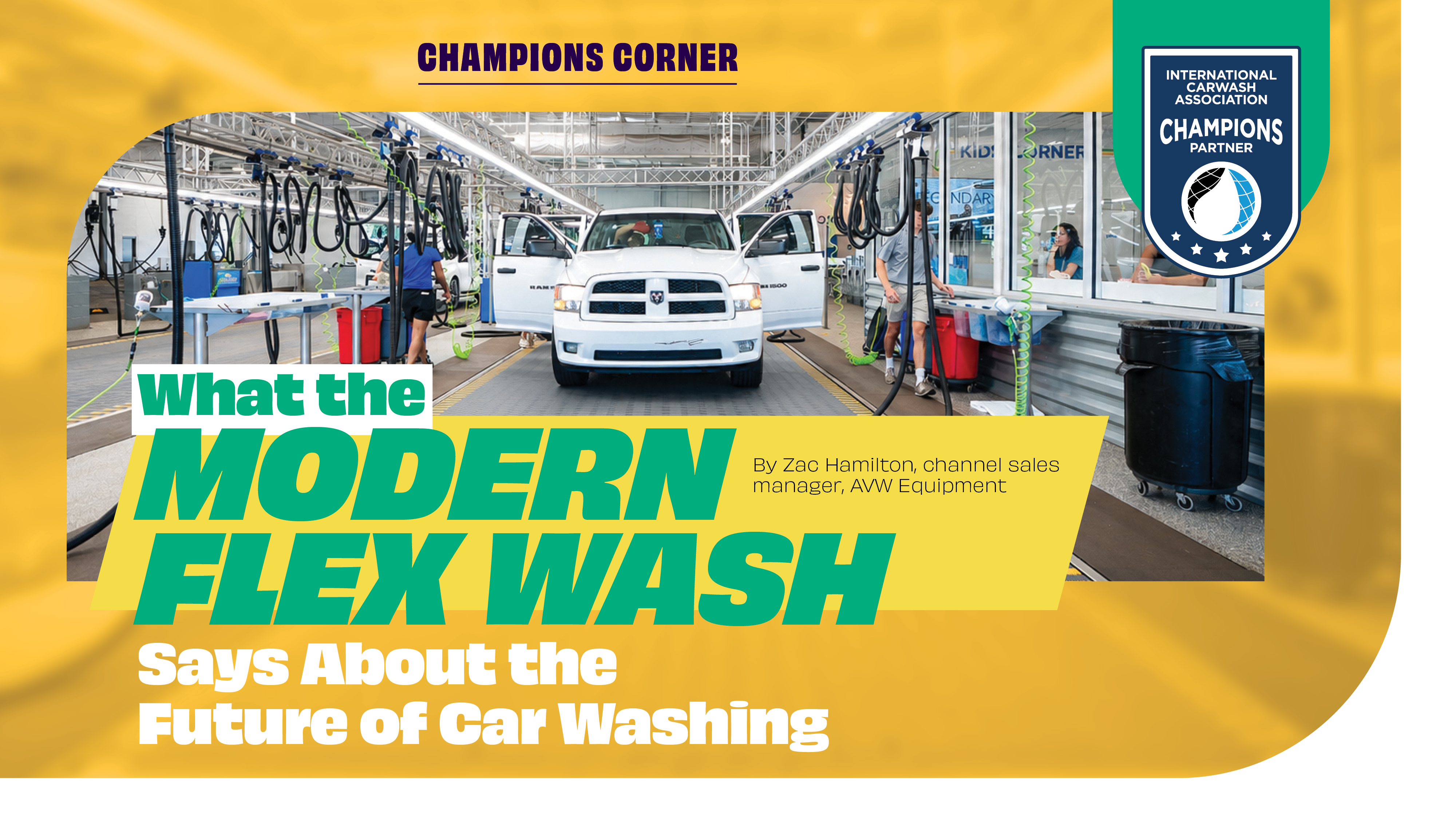
Instead of building another standard express site, Dittman and his team built what he calls a “destination car wash.” The 35,000-square-foot mega flex site includes two 140-foot wet tunnels, 22 self-serve vacuum stations and three AVW detail belts designed to help deliver a full-service interior and exterior wash in 15 minutes or less.
“We wanted to make a statement piece,” Dittman says. “We wanted to build a destination car wash.”
The statement isn’t just size; it’s about building an operation where the service, customer flow and equipment layout all support each other.
At Super Dave’s, the detail belt is central to that process. Rather than having employees crowd around a stationary vehicle, the car moves through a defined series of stations. Mats are removed. Debris is blown out. Glass is cleaned. Surfaces are wiped. The vehicle is vacuumed. A supervisor performs quality control before the customer leaves.
“From an efficiency and productivity standpoint, it allows your crew to stay focused on their one task,” Dittman says.
That matters because modern flex cannot depend on hustle alone. It needs a repeatable system that both employees can be trained on and managers can measure. Dittman adds that the goal is to give customers the quality of full-service without asking them to give up their afternoon.
“People’s time is the most important thing they have,” he says.
That same idea can be found at Splash Car Wash in Arkansas. Splash has used big-box conversions, including a former trampoline park and a former Walmart, to build larger flex locations that offer exterior and interior cleaning. Those locations work alongside express exterior sites in a “hub-and-spoke” model.
Justin Young, Splash’s vice president of marketing, says the company saw an opportunity to differentiate by going beyond the express wash model.
“The services we wanted to offer, you can’t fit in an express wash tunnel,” he says.
For Splash, the opportunity was not simply adding services but solving a problem. Many customers wanted a cleaner interior, but their options were limited to doing it themselves with free vacuums or leaving the vehicle for a full detail, which could cost more and take much longer.
“There was no middle ground, really,” Young says.
That middle ground is where modern flex has room to grow. Customers can still get the speed and convenience they expect, but operators can add value through comfort, hospitality and a more complete car care experience.
The challenge is making it operationally realistic.
Consistency through prioritizing the process
At Splash, the AVW detail belt supports a conveyorized interior process that helps make cleaning more predictable. At Super Dave’s, it helps organize a large production team around assigned stations. In both cases, the equipment is not simply a feature of the site, but part of the business strategy.
Michael Timmer, sales representative/technical specialist at AVW Equipment, says the strongest flex operators are not just adding interior service to the menu.
“They’re building a process around it,” Timmer says. “The customer flow, employee workflow and equipment layout all have to support the same promise: more service without giving up speed or consistency.”
That is also why the vendor relationship matters. A modern flex site puts more demand on the entire wash package. The tunnel still has to produce a clean, dry exterior. The interior operation has to move on a predictable timeline. The equipment has to support the labor model instead of forcing employees to work around it.
For operators like Super Dave’s and Splash, AVW’s role extended beyond supplying individual pieces of equipment. The partnership supported a larger operating model: belts, tunnel layout, stainless steel equipment, serviceability and practical guidance from a team that understands how different wash formats perform in the field.
Paul Stagg, chairman of Splash, says that industry knowledge was part of the value.
“The resource that they are to me is as important as the equipment,” Stagg says.
Dittman describes the relationship in similar terms, pointing to the importance of working with a partner that could support future growth, not just one location.
“That relationship to me is irreplaceable,” he says.
For operators considering whether flex belongs in their market, the question is not simply whether customers want interior service. Many do. The better question is whether the operation can deliver that service consistently, efficiently and profitably.
Questions operators should ask before adding flex or interior service:
- What customer problem are we trying to solve?
- Can the service be completed on a predictable timeline?
- Does the site layout support customer flow and employee workflow?
- What staffing model is needed and can each role be trained clearly?
- How will managers protect quality during peak volume?
- Does the equipment support the process or does the process have to work around the equipment?
- How will the service strengthen customer loyalty beyond price or promotion?
Express exterior washing is not going away. For many sites it remains the right model. But as more markets mature, operators are looking for ways to create value that customers can feel.
Super Dave’s and Splash show two different paths. One is a ground-up destination model built around scale, speed and premium experience. The other is a market-wide strategy using big-box flex sites and express locations together.
The common thread is not size, it’s intentional design.
Modern flex works best when every part of the operation supports the same goal: giving customers more service without giving up the speed, quality and consistency that brought them to professional car washing in the first place. For operators ready to build that kind of model, the right equipment and the right vendor partner are not secondary details. They are part of what makes the model possible.
.png?width=1920&height=1080&name=CAR%20WASH%20Exchange%20Banner%202%20(8).png)