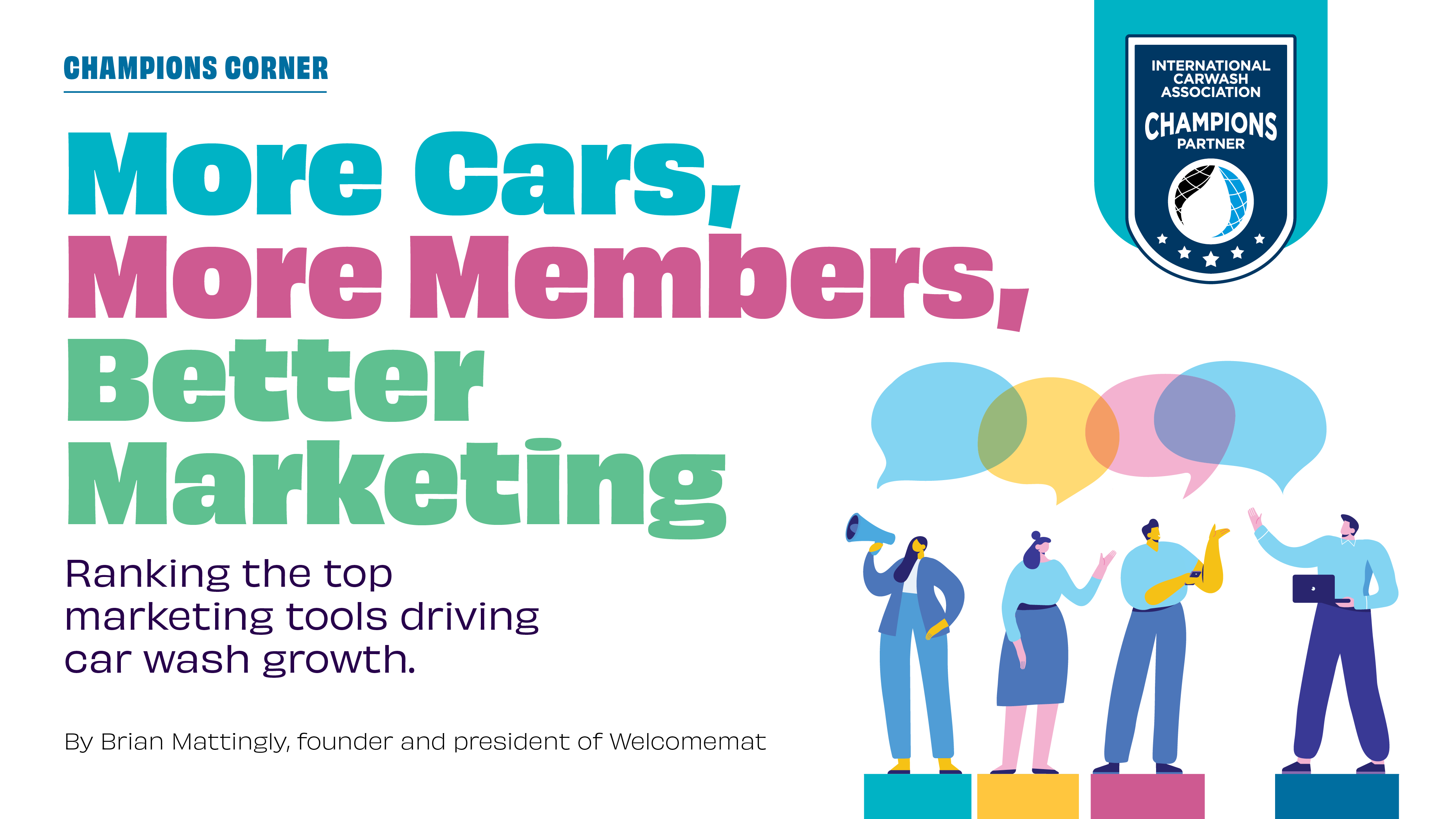
More Cars, More Members, Better Marketing
Brian Mattingly
|
Ranking the top marketing tools driving car wash growth.
Every operator eventually asks: Where should the next marketing dollar go?
Knowing which growth tools pull their weight matters more than ever. Today, there’s enough data — some industry-wide, some pulled directly from car wash operators’ own campaigns — to actually rank marketing channels by what they return.
We modeled seven channels and connected them to actual car wash revenue: a visit becomes either a single retail wash or a membership. Using real cost data from operators, published industry benchmarks and first-party data, we built a return-per-dollar figure for each channel. The results are ranked below, highest to lowest.
SEO/Google Business Profile: $34.35 per $1 spent
Local search — the combination of a well-optimized Google Business Profile and organic search rankings — topped the list. The figure comes from real client results, tracking website clicks and direction requests through to actual visits and membership sign-ups.
The ranking return number was largely based on established brands. Newer or single-location operators should expect lower initial returns, since part of that performance comes from already loyal customers. SEO also takes time. Operators starting from scratch should expect six to 12 months before seeing similar returns. Once established, it tends to keep generating steady returns with little additional spend.
The strength of the website matters. A modern, technically sound infrastructure ranks and converts better than one that isn’t, especially as AI-powered search results increasingly decide which businesses get surfaced at all. Even discounted for these factors, local search still led every other channel tested.
Email: $22.15 per $1 spent (blended)
Email’s return depends almost entirely on size — the bigger and more engaged the list, the more a flat monthly platform fee gets diluted and the stronger the return. The blended midpoint across list sizes landed at $22.15, roughly in line with the $36 to $48 range widely cited in national marketing research.
List hygiene matters just as much as size. Google and Microsoft have improved spam filtering in recent years, and a list full of stale or unengaged addresses can tank deliverability fast, sending campaigns straight to spam instead of inboxes. Finding an email partner who understands deliverability and helps keep a list clean rather than just bigger is worth the effort.
Combined Google Ads and SEO: roughly $22 per $1 spent
Appearing in both paid and organic slots on a search results page captures more total attention than either alone — Google’s own research found that when a business ranks first organically, about half of the clicks its paid ad receives are still incremental, meaning genuinely new. Layering paid search on top of a strong organic position adds value, but it isn’t purely additive, since some of that paid traffic would have found the business organically anyway.
There’s a strategic argument for running both that a single dollar figure doesn’t fully capture. Organic rankings shift with Google’s algorithm, sometimes with little warning. Paid placement doesn’t move. For operators who depend on steady lead flow, a modest, consistent ad budget can hedge against the volatility of relying on organic rankings alone.
Meta (Facebook and Instagram) ads: $15.13 per $1 spent
Meta’s advantage is cost. Well-run campaigns can bring in leads for under $1 apiece, though the more typical figure sits closer to $2.30 — still well below what most washes pay for a Google click. Because the cost per lead is so low, even a modest visit-to-membership conversion rate produces a strong overall return.
That return depends heavily on targeting discipline. Campaigns that repeat the same offer to someone who already filled out a form or that fail to exclude existing members from acquisition ads waste spend fast and can erode Meta’s advantage quickly. Geography matters just as much — a wide radius pulls in impressions from drivers who will never realistically visit, burning budget on an audience that was never reachable in the first place.
New-mover mailers: $13.27 per $1 spent
Mailers sent specifically to households that just moved into an area outperformed general mailings by roughly double. New residents haven’t settled into routines and tend to stick with their first picks, including the car wash and grocery store, much longer than established residents. That makes new movers an unusually high-quality target and a strong source of new members.
The catch is scale. A market might produce only a hundred or so new-mover addresses in a given window, compared with the thousands or tens of thousands available for a standard mailing list. The return per dollar is excellent, but the audience is inherently small, so new-mover mail works best as a high-quality supplement to a broader marketing mix rather than a primary growth channel on its own.
SMS: $11.94 per $1 spent (blended)
SMS has been a standard tool for car wash operators for years, and for good reason. It’s fast, and it gets a response quickly. It’s especially effective for delivering time-sensitive offers. The challenge is that opt-out rates have crept up over the past several years, whereas opt-outs for email remain comparatively rare. Knowing when to use SMS and when to hold back matters. Operators who reserve it for genuinely timely offers tend to keep opt-outs manageable. Like email, text messaging carries a flat monthly platform fee, so its return scales with list size.
General postcard direct mail: $6.59 per $1 spent
General postcard campaigns can generate solid profits. Appropriate radius targeting matters — finding the geographic sweet spot where recipients are more likely to become members, rather than mailing indiscriminately across a wide area.
A few other factors separate strong postcard campaigns from mediocre ones. Dropping mail during a noisy season like the holidays can hurt performance simply because a mailbox full of competing offers makes any single piece easier to ignore. When postcards are dropped in the same area as a digital campaign, both mail and digital results tend to improve, suggesting the two reinforce each other rather than compete. And postcards that push recipients to a dedicated digital landing page, rather than a generic website, tend to convert better than mail alone.
Google Ads: $4.03 per $1 spent
A 4-to-1 return on ad spend is a strong number by any standard, even though it landed at the lower end of this ranking. Cost per lead on Google tends to run several times higher than on Meta, which brings the multiple down. But Google Ads capture something the other channels can’t: people who are actively searching for a car wash right now, at the exact moment they’re deciding where to go. That kind of high intent is difficult to replicate.
Capturing it increasingly means showing up in multiple places on the results page. Sponsored placements in the Google Map Pack — the map with nearby business locations that appears when someone searches — alongside the newer AI-generated search results now appearing on many queries are becoming essential real estate for reaching these high-intent searchers before a competitor does.
The Takeaway
No single channel fits every operator, and the numbers above are strongest as a starting point, not a formula. List size changes email and SMS economics dramatically. Mailing list quality changes direct mail economics dramatically. And an operator’s own brand strength affects how far local search dollars go.
What the ranking does make clear is this: channels built around a wash’s own customer relationships — its list, its community involvement, its Google presence, its local reputation — consistently outperformed channels built around renting someone else’s audience. That’s a useful principle for any operator deciding where next year’s marketing budget should go.