CAR WASH Magazine
Car Wash
How Top Operators and Innovators Are Defining the Industry’s Future
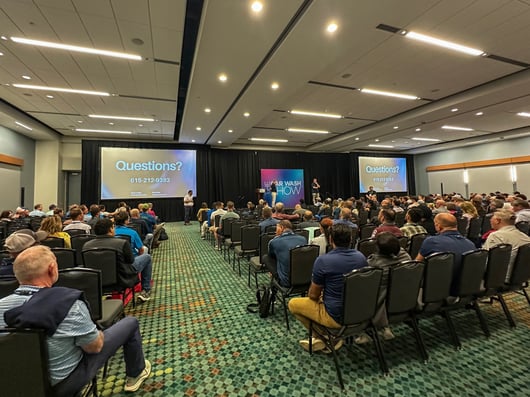
The car wash industry gathered in Nashville, TN, this spring for The Car Wash Show 2026, hosted by the International Car Wash Association, where thousands of operators, vendors, consultants, and investors converged to explore the future of an increasingly sophisticated and competitive sector.
While the exhibit halls showcased everything from tunnel automation systems and chemical innovations to membership platforms and operational software, a deeper theme emerged throughout the event: success in the modern car wash industry is increasingly determined not by equipment alone, but by how effectively operators combine technology, recurring revenue, customer experience, and brand differentiation.
Across conversations with operators, consultants, and suppliers, four consistent forces stood out: technology adoption, knowledge sharing, experiential marketing, and the growing importance of customer engagement as a competitive differentiator.
While technology and customer experience dominated many conversations at The Car Wash Show 2026, broader economic forces continue to shape the industry's direction.
Chris Hovinga of Momentum Car Wash Specialists believes the most significant changes over the past five years have been driven by shifts in capital markets, construction costs, and the growing importance of recurring revenue.
"The car wash industry looks very different today than it did five years ago," Hovinga said. "The post-pandemic world, rising construction costs, and a dramatic shift in interest rates have reshaped how operators build, invest, and grow."
According to Hovinga, the industry's rapid expansion has moderated as higher land, construction, equipment, and financing costs have made new developments more difficult to justify.
"When borrowing money becomes expensive, the math on a $4 million to $6 million new build gets a lot harder to make work," he said.
As a result, many operators are shifting their focus from geographic expansion to operational optimization.
"Some of the smartest operators are putting capital to work inside their existing footprints," Hovinga explained. "They're upgrading equipment, improving site flow, increasing capacity, and investing in technology that drives throughput without adding headcount."
For those sites that are still being developed, he sees a clear trend toward smaller, more efficient designs.
"The sites being built today are smaller, faster, more visually striking, and require fewer employees on-site," Hovinga said. "Automation, advanced chemical systems, and modern payment technology are helping operators deliver a better customer experience with less friction."
Perhaps the most significant industry transformation, however, has been the continued growth of unlimited membership programs.
"The single biggest shift in the business over the last five years isn't operational—it's the membership model," Hovinga said.
Memberships have become increasingly important because they provide recurring revenue, help reduce weather-related volatility, and encourage customer loyalty. For many operators, subscription programs now serve as the foundation of long-term financial stability.
Looking ahead, Hovinga believes the greatest opportunities lie in maximizing the performance of existing assets rather than simply building additional locations.
"The bar has been raised," he said. "Customers are more sophisticated, competition is more intense, and the margin for operational sloppiness is thinner than it used to be."
He points to four areas where operators can create meaningful returns: investing in equipment upgrades that increase throughput and reduce downtime, building stronger membership programs, leveraging automation to reduce labor dependency, and improving the overall customer experience through site enhancements.
Ultimately, Hovinga sees successful operators creating what he describes as a continuous improvement cycle.
"Returning customers, returns on investment, and continuous reinvestment all feed one another," he said. "The operators who understand that loop are the ones creating long-term value."
Among the independent operators attending the show was Oliver Jenkins, who represents a growing class of industry entrants coming from finance, technology, and investment backgrounds.
Jenkins, a lifelong investor, tinkerer, and car enthusiast, recently acquired a self-service wash in Reading, Pennsylvania, featuring four self-serve bays and one in-bay automatic system. After nearly a decade in finance and technology, he described the transition into car wash ownership as both intuitive in concept and unexpectedly complex in execution.
“Car washes may be simple in concept, but they are full of expensive, high-powered equipment that needs to be dialed in just right to give customers the best possible experience,” Jenkins said. “It took me three to four months to really feel like everything was calibrated properly and that I could fix anything that went wrong.”
One of the biggest challenges, he noted, was developing systems for maintenance, cash handling, and inventory management. Leveraging his technology background, Jenkins ultimately developed his own AI-assisted management platform to help streamline maintenance schedules, reporting, inventory tracking, and operational workflows.
Yet even with strong systems in place, unpredictability remains part of daily operations.
“Even if everything is working well, you never know when a hose could break, a coin counter could jam, or a changer could malfunction,” he said. “Whether someone enjoys running a car wash depends on whether they find those daily challenges engaging or draining.”
For Jenkins, the educational sessions at The Car Wash Show proved especially valuable. One standout presentation, “Five Major Improvements in Self-Service Car Washing,” delivered by Brent McCurdy, helped clarify the cost-benefit tradeoffs of future capital investments.
“As a newer owner, I’d already tackled most of the obvious low-hanging fruit,” Jenkins said. “What I needed was confidence about which larger investments were actually worth making next.”
Technologies discussed throughout the show included bay dryers, wall system upgrades, LED lighting improvements, and membership-based revenue platforms designed to increase customer retention and recurring income.
Beyond equipment and technology, many attendees emphasized the importance of education and peer networking in an industry undergoing continued consolidation.
Ben Branam of AutoBrite Company, which specializes in Mini Express Car Wash Tunnel systems, believes industry events are becoming increasingly important for independent operators seeking to remain competitive.
“The bigger chains just have more data, more people, and more customer interactions to work with,” Branam said. “Smaller operators can close some of that gap simply by building relationships and learning from others in the industry.”
Despite competitive pressures, Branam described the car wash community as unusually collaborative.
“Every operator has their own secret sauce about how they wash a car, market, and treat customers,” he said. “But almost everyone is willing to share what they’ve learned if you take the time to ask and listen.”
Branam emphasized that the most successful attendees engage across three dimensions: education, networking, and execution.
“People who attend these educational classes generally do better,” he said. “A lot of attendees walk the trade show floor looking only for equipment, and that’s a mistake.”
The true value, he noted, often comes after the event ends.
“The network effect is real,” Branam said. “But ultimately, the biggest differentiator is whether someone actually tries something new after the show.”
For operators evaluating new equipment and systems, he stressed that online research can only take them so far.
“Researching equipment online gives you the ‘what,’” Branam said. “But new operators still need the ‘how’ and the ‘who.’”
While operational efficiency and technology dominated many conversations, another theme gaining traction is the role of branding and customer experience in driving long-term competitiveness.
Kai Zhang, founder of Alligator Merchandise, highlighted a growing demand for customized, high-impact marketing products designed specifically for car wash operators.
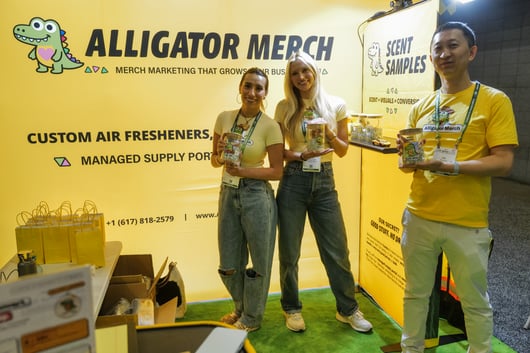
One of the most creative projects his company recently produced involved a gemstone-branded car wash seeking a highly visible promotional item.
“Instead of reinventing the product, we reinvented the presentation,” Zhang said. “We created an oversized paper air freshener shaped like a giant gemstone, covered in reflective sparkle elements so it caught attention instantly. You just can’t possibly miss it, even from across a parking lot.”
The project reflects a broader shift in how operators view marketing materials—not as generic giveaways, but as extensions of brand identity.
“That’s where we think the best custom merch lives,” Zhang said. “Not in gimmicks, but in creative design on something people use every day and actually appreciate.”
According to Zhang, the industry's increasing competitiveness is pushing operators toward premium positioning rather than price-based competition.
“The car wash industry has become more competitive, and a lot of smart operators are realizing they can’t win by racing to the bottom on price,” he said. “They have to compete on value and brand experience.”
Promotional products, he added, are increasingly being used as retention tools rather than simple acquisition incentives.
“Our custom merch are not just giveaways,” Zhang said. “They’re tangible reminders of the customer’s membership experience and the brand behind it. That makes them powerful tools for both conversion and retention.”
The growing emphasis on customer experience is also influencing the vendors that serve the industry.
At The Car Wash Show 2026, one of the most talked-about promotional campaigns came from AVW Equipment, which introduced Benny the Belt, a plush mascot inspired by the company's conveyor technology.
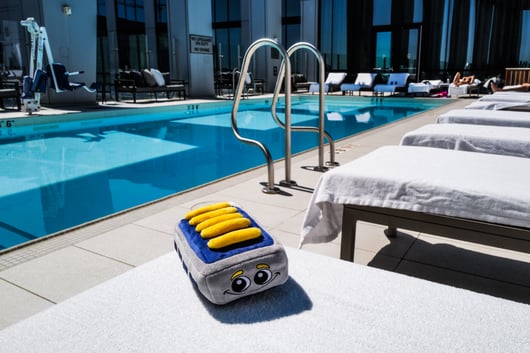
According to Jennie Bosas, Marketing Coordinator at AVW Equipment, the character originated from a broader initiative known as the AVWFriends, designed to humanize equipment and create stronger connections with the next generation of car wash professionals.
“Benny the Belt grew out of a broader creative direction our Marketing Director, Danka Dubak, had been envisioning for AVW,” Bosas explained. “The idea was to humanize our equipment in a way that felt approachable and relevant to the next generation of car washing professionals.”
Bosas, whose background includes children's illustration and plush design, helped transform one of AVW's core equipment offerings into a recognizable and engaging character.
The initiative also reflected the values of the family-owned company. With the recent arrival of Vaso, the fourth generation of the AVW family, Nashville provided an opportunity to celebrate themes of legacy, family, and long-term commitment to the industry.
While the plush mascot attracted attention on the show floor, attendee engagement was the true objective.
“Attendee interaction was central to the campaign,” Bosas said. “The goal was not just to create another piece of branded swag. We wanted Benny to feel like a character people could actually connect with.”
To extend the experience beyond the booth, AVW encouraged attendees to photograph Benny throughout Nashville and share their adventures on social media.
“The social media component gave attendees a reason to take Benny beyond the booth and make the experience their own,” Bosas said. “It helped create emotional recall in an industry that can often be very staid.”
One of the campaign's most successful elements was a claw machine that allowed attendees to win their own Benny plush.
“At first, some attendees were a little skeptical,” Bosas recalled. “You could tell they were thinking, ‘What is this doing at a car wash trade show?’ But once they stepped up, grabbed the controls, and saw that machine light up, the energy shifted completely.”
Children, spouses, and longtime industry veterans alike participated, creating moments of excitement amid the more technical exhibits throughout the convention center.
“When the claw dropped and someone won a Benny, they reached into the prize door like they had just won something special,” Bosas said. “People walked away smiling, holding Benny, taking photos, and talking about AVW in a way that felt natural. For us, that was the win.”
The campaign illustrated a broader trend visible throughout the event: successful brands increasingly understand that memorable experiences create lasting connections.
As The Car Wash Show 2026 concluded, conversations throughout the event reflected an industry in transition: moving away from fragmented, independently operated businesses toward a more data-driven, customer-focused, and professionally networked ecosystem.
From operators like Oliver Jenkins refining operational systems through technology, to industry leaders like Ben Branam emphasizing education and peer collaboration, to marketing innovators such as Kai Zhang and Jennie Bosas demonstrating the growing importance of brand experience and engagement, the message across the show floor was remarkably consistent. Chris Hovinga provided a broader economic perspective, highlighting how rising costs, operational optimization, and membership-driven revenue models are reshaping investment decisions across the industry.
Success in the modern car wash industry is no longer defined by equipment alone.
The operators and suppliers gaining momentum are those who can effectively combine technology, operational discipline, customer experience, branding, and industry relationships into a cohesive strategy. The car wash industry's next generation of leaders may not necessarily be those with the newest equipment or the largest footprints, but those best able to integrate these elements into a repeatable, customer-focused business model. As competition continues to intensify, that combination may prove to be the industry's most durable competitive advantage.
Randy Scott Wong is an automotive and business journalist covering specialty vehicles, motorsports, branding, and emerging trends. His work focuses on the people, technologies, and strategies shaping the future of businesses. Currently a successful real estate developer and entrepreneur, he is also an avid motorsports enthusiast and former professional, having test ridden the fastest BMW production sport motorcycle at the time, for 44 laps on the famous Nurburgring Nordschleife.
-1.png?width=1920&height=1080&name=CAR%20WASH%20Exchange%20Banner%202%20(2)-1.png)